When it comes to lens filters in food and beverage photography, understanding the difference between ND filters vs. circular polarizers is the key to controlling light, reflections, and depth of field with intention.
Two essential lens filters. Two completely different jobs. Here’s how to know exactly which one to reach for , and when.
There’s a moment most beverage photographers know all too well. You’re on set, a variety of glassware in front of you, light perfectly positioned. You look through the viewfinder and see it: an ugly hotspot crawling across a label, or a glaring softbox reflection on a glass of wine.
Or the opposite problem: your strobe is overpowering everything. You’re forced to stop down to f/11, and all that gorgeous, creamy bokeh you planned just disappears.
You know you need a filter. You might even have both filters in your bag. But which one should you choose?
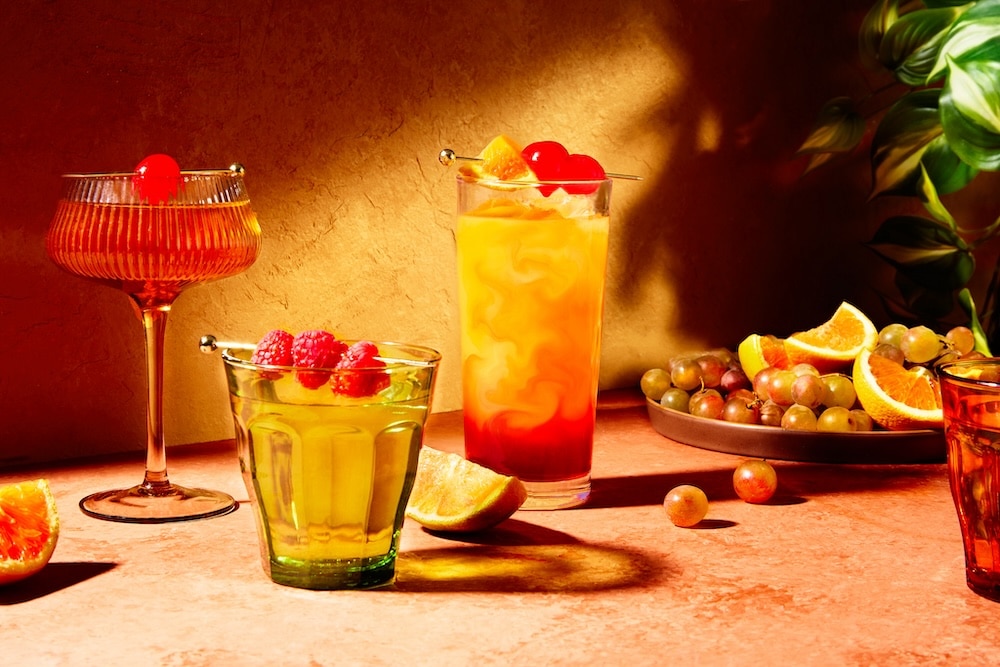
This is the exact situation I found myself in early in my beverage photography career. I understood both filters in theory (I’d learned the basics in photography school), but applying that knowledge to the specific demands of glass, liquid, and controlled studio lighting felt different. There was a gap between knowing what a tool does and knowing when you actually need it.
This guide closes that gap. By the end, you’ll understand not just what each filter does, but the specific visual problems each one solves, so you can make fast, confident decisions on set.
Before we talk about the application, let’s lock in the fundamentals. These two filters are frequently grouped together because they both reduce light. However, they operate on entirely different principles.
Think of an ND filter as a pair of sunglasses for your lens. It reduces the amount of light reaching your sensor by a fixed, measured amount — 1 stop, 2 stops, 3 stops, 6 stops, and so on — without affecting anything else.
No colour shift, no change to contrast, no effect on reflections or how light behaves. Just less of it.
ND filters are available in two main formats: fixed (a single, defined stop reduction) and variable (a rotating design that lets you dial in your desired reduction across a range, typically 2–8 stops). Variable NDs offer flexibility on set, but note that high-quality glass matters. Cheap variable NDs can introduce colour casts, especially at higher densities.
The key point: an ND filter gives you control over exposure without changing your aperture or shutter speed. That’s it. That’s the whole job.
A circular polarizer works on a completely different principle. Light travels in waves that vibrate in all directions. When light bounces off a non-metallic surface, such as glass, water, liquid, or lacquered labels, it becomes polarized, meaning those waves are now vibrating predominantly in one direction.
A CPL filter is designed to block that polarized light before it reaches your sensor.
In practice, this means you can rotate the filter until unwanted reflections reduce or disappear entirely. The effect is immediate and visible through the viewfinder: you watch reflections appear and vanish as you turn the ring. It’s one of the most visually satisfying tools in a photographer’s kit.
A side effect of this process is that a CPL cuts approximately 1.5 to 2 stops of light. This is useful to know for exposure, but it is not the filter’s primary function and shouldn’t be the reason you reach for it.
The simplest way to remember the difference: an ND controls the quantity of light. A CPL controls the quality of light.
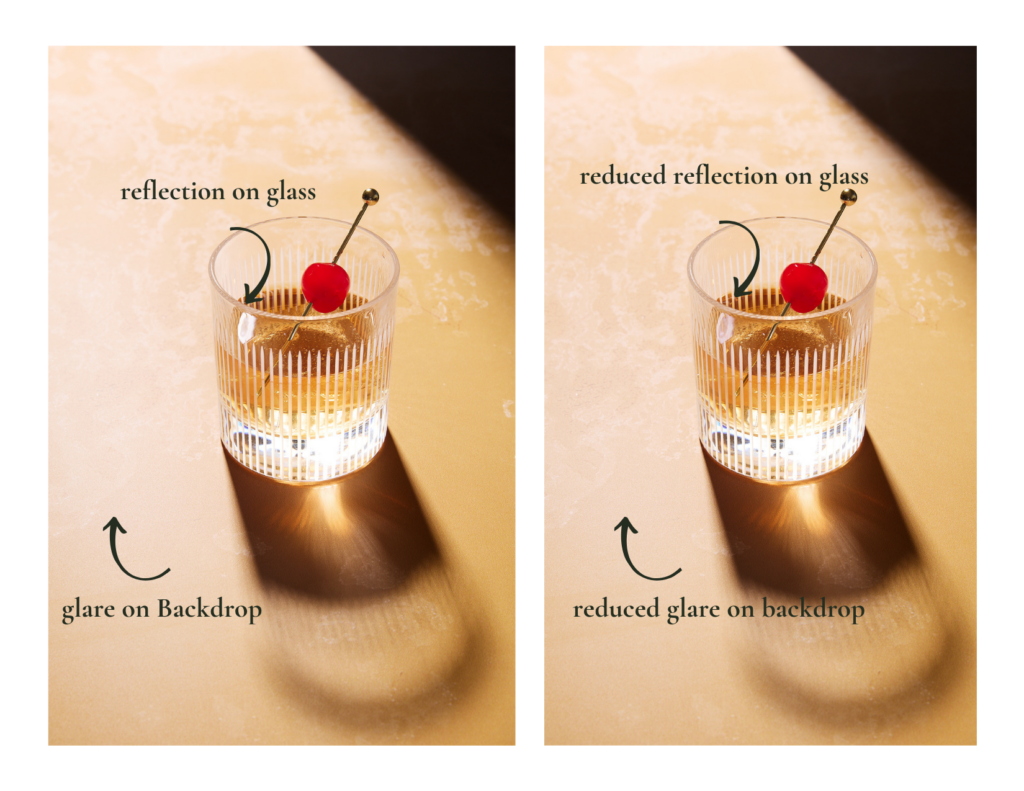
In this image, an CPL was used to reduce the glare on the backdrop and the hot spot on the glasss.
The ND filter earns its place on set in one specific scenario: when your light source is too powerful for the aperture and shutter speed combination you want to shoot at.
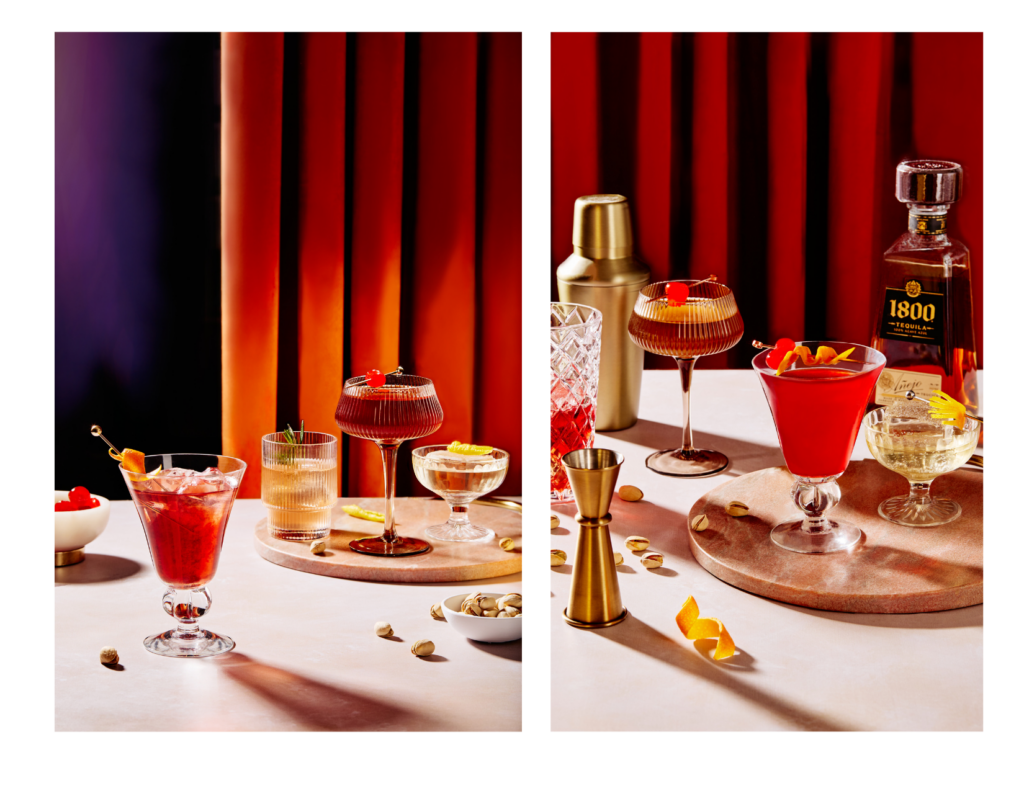
This is the most common use case in editorial beverage work. You want a wide aperture for that shallow depth of field that makes foreground bottles sharp while background elements blur into a soft, dreamy wash. But you also need a strong backlight behind the glassware to make the liquid glow.
The problem: even at your strobe’s minimum power output, the scene is overexposed at f/5.6. The math doesn’t work. Without intervention, you’re forced to stop down to f/8 or f/11, and the entire aesthetic of the shot changes. The background bottles go sharp. The bokeh disappears. The image loses that cinematic, editorial quality.
Drop in a 2- or 3-stop ND filter and the problem disappears. You’re back at f/2, the strobe is at a workable power, and the exposure is correct.
Another scenario where an ND earns its place is when you’re mixing strobe lighting with continuous sources such as practical lights, a daylight window, or a glowing neon sign used as part of the scene.
To balance a slower continuous source against a faster strobe, you might need a longer shutter speed, which in turn affects your aperture choices. An ND filter gives you additional latitude to fine-tune that balance without compromising your creative intent.
This matters as much as knowing when to use it. An ND filter will not:
If you’re fighting reflections and you reach for an ND, you’ll be disappointed. It will make your overexposed reflection darker, but it won’t make it disappear.
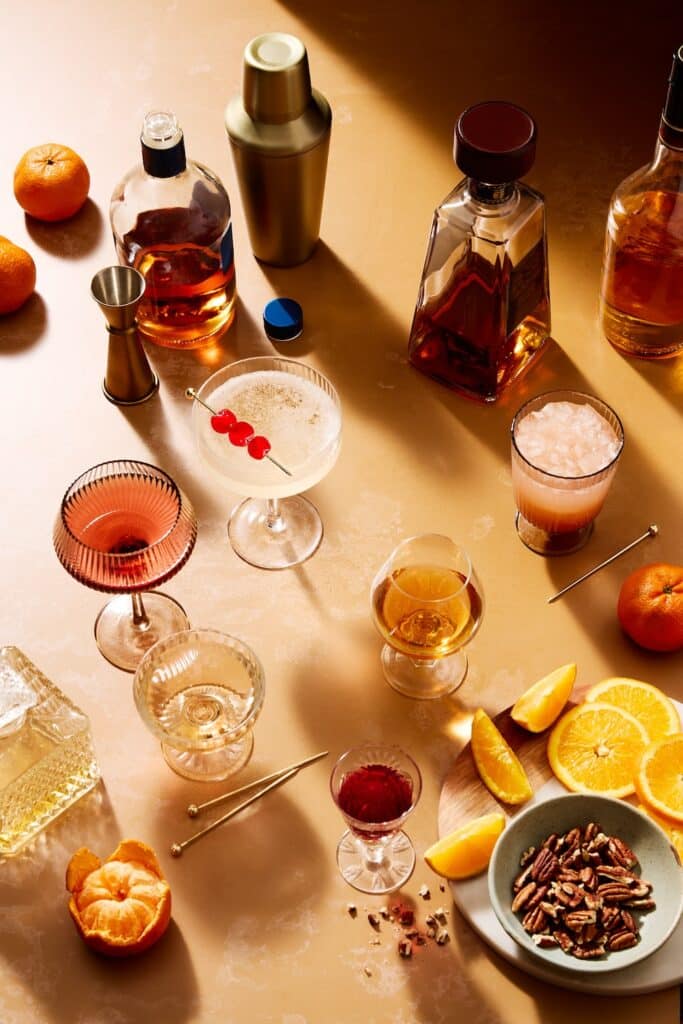
The CPL filter is one of the few tools in photography that produces results you genuinely cannot replicate in post-production. Photoshop is powerful, but it cannot selectively remove polarized light from a curved glass surface the way a CPL can in-camera. That alone makes it indispensable for serious beverage work.
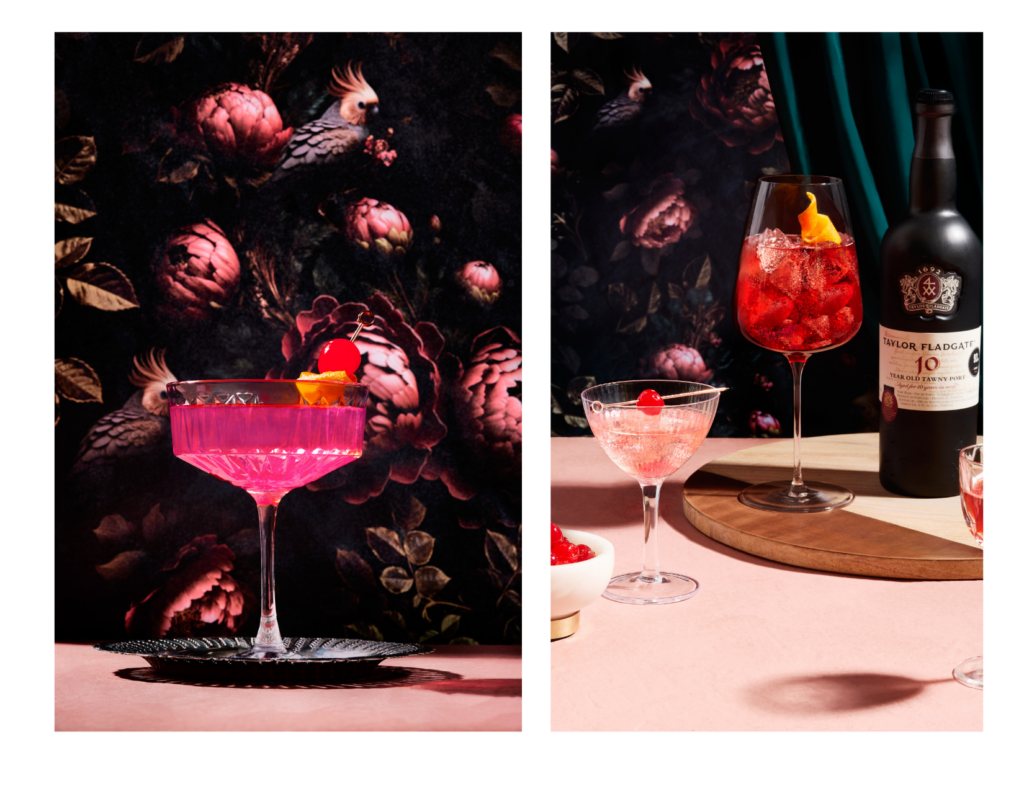
Curved glass surfaces such as wine glasses, beer pints, cocktail coupes, and rounded bottles act like mirrors for your light sources. Position a large softbox to the side or above, and you’ll often see a curved, elongated reflection of the modifier draped across the glass. Mount a CPL, rotate slowly, and watch the reflection fade. Even partial reduction is often enough to clean up a shot that would otherwise require extensive masking in retouching.
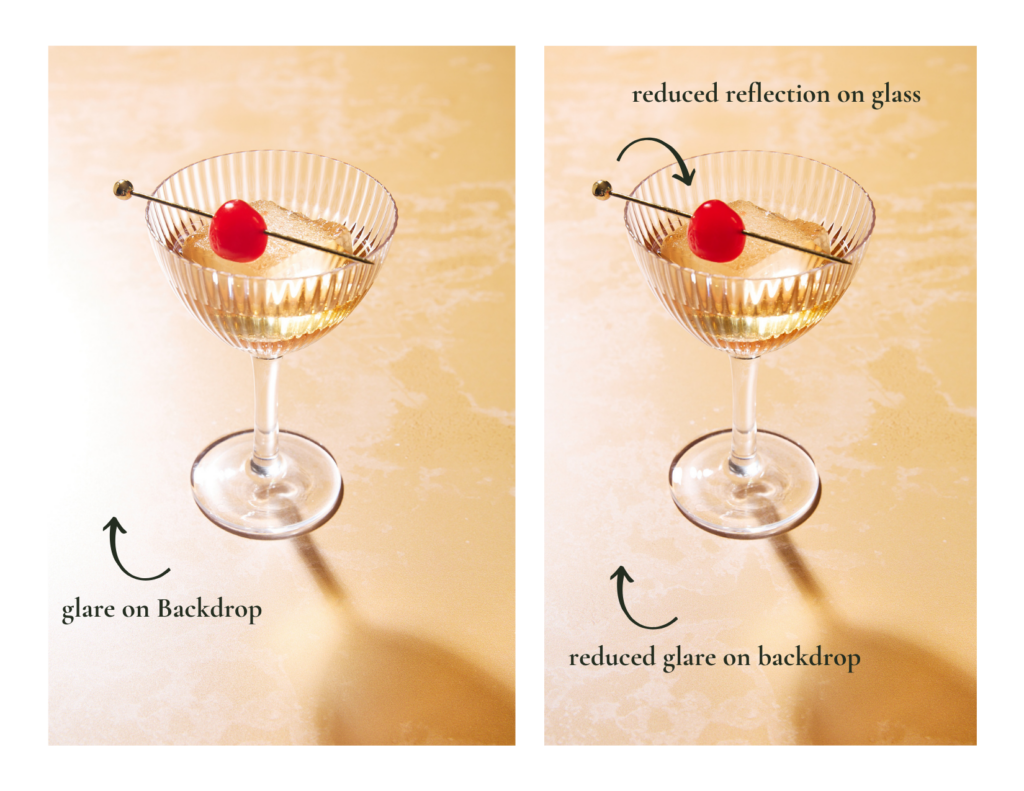
In this RAW, unedited image, the use of a CPL reduced the glare on the backdrop and the glassware.
Bottle labels present a specific challenge. Paper and matte-finish labels are relatively easy to light, but glossy labels, lacquered surfaces, or labels printed on foil can catch and scatter light in ways that obscure the type and artwork your client needs to be legible. A CPL is often faster and more effective than repositioning lights or flagging. You can dial in exactly how much reflection to remove while keeping the lighting arrangement that flatters the liquid and glassware.
When light hits the surface of a liquid and scatters back toward the camera before passing through, it desaturates what you see. A CPL removes much of that scattered surface light, allowing the transmitted colour to read more richly. For example: the amber of a craft ale, the deep garnet of a Shiraz, the translucent green of a cucumber gin. The difference can be subtle or striking, depending on the liquid, but it’s almost always an improvement.
The surface of a cocktail can also develop bright, blown-out hot spots when light hits at certain angles. This can also happen with your backdrops. The drink is lit perfectly, but there is glare on the backdrop. While adjusting light position is always a solution in these scenarios, there are setups where the geometry of the shot makes that impossible without compromising another part of the frame. In those situations, a CPL can reduce the intensity of those surface highlights while leaving the rest of the scene intact.
When I’m setting up a shot, I run through two diagnostic questions. This has become second nature, but writing it out explicitly made it easier to teach to assistants.
Ask yourself:
🔹 Am I fighting reflections on glass, liquid, or labels? → Reach for the CPL.
🔹 Am I fighting overexposure because I want a wider aperture? → Reach for the ND.
These two questions cover the vast majority of situations where a filter will help. If the answer to both is yes — for example, you need a wide aperture and you’re fighting reflections — you may need to layer both filters or prioritize which problem is more damaging to the shot. In practice, this is rare, but it does happen.
If neither question triggers a “yes,” a filter probably isn’t your solution. Look at your light placement, your modifiers, or accept that the fix will happen in post.
Filter quality matters more in controlled studio work than in most other photography contexts. In beverage work, where your client is paying you to render their product’s colour accurately, a filter that introduces even a subtle colour shift can create problems.
One of the things that has consistently elevated my beverage work is borrowing from the visual language of cinematography. Film DPs have been solving the problems of liquid, glass, and controlled light for decades — and the tools and techniques they’ve developed translate remarkably well to still photography.
ND filters are standard issue on any professional film set. The ability to shoot at a specific aperture and achieve a specific depth of field and bokeh quality, regardless of light intensity, is fundamental to the cinematic look. Cinematographers don’t stop down when the light is bright; they add ND and maintain their chosen aperture.
Understanding these filters as part of a deliberate approach to image-making, rather than as occasional problem-solvers, changes how you think about shooting. You stop reacting to problems and start designing around them.
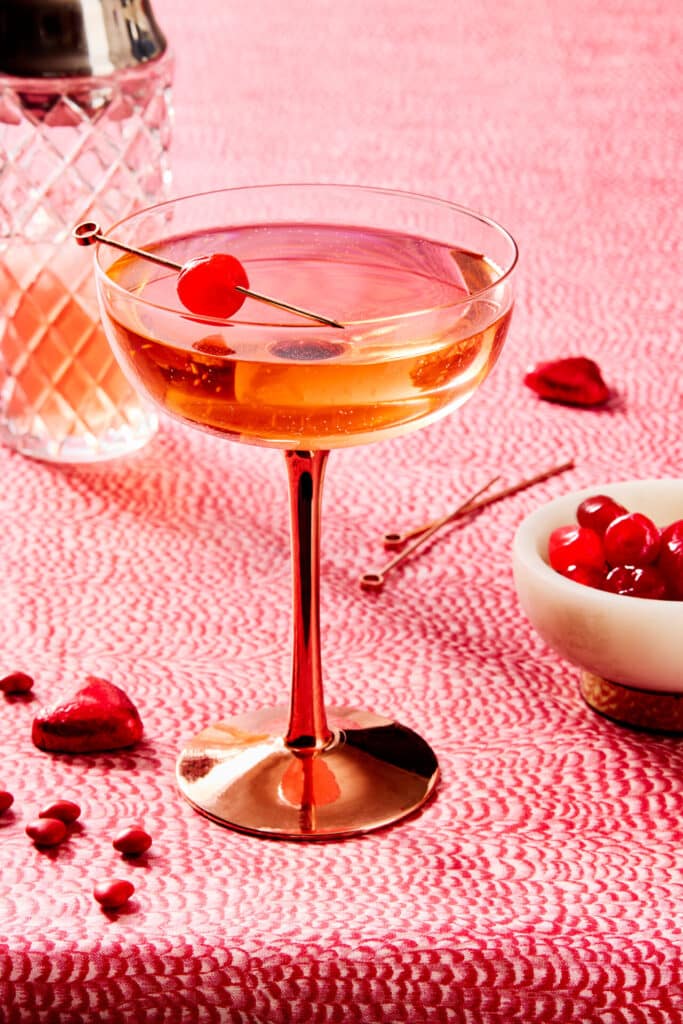
ND filters and circular polarizers are not interchangeable, and they’re not really competing for the same job. One controls how much light reaches your sensor; the other controls the behaviour of light before it gets there.
If you’re fighting overexposure and want to shoot wide open: ND filter.
If you’re fighting reflections on glass, liquid, or labels: CPL.
Mastering these two tools won’t make every shot easy, but they’ll remove a significant class of problems from your list — problems that are otherwise expensive to fix in retouching and difficult to fix convincingly.
Want to learn more about creating stunning beverage photos? My eBook LightShaping: Getting Started with Artificial Light for Food Photography will give you the perfect foundation for using artificial light. You’ll get a bundle of four PDFs: an eBook that is over 100 pages, a gear guide, and exposure guide, and a principles of light cheat sheet that you can have handy when you’re shooting to help you understand what your light source is going to do as you adjust it.